There are scandals.
And then there are scandals so monstrous that they cease to be scandals altogether and become indictments of an entire civilisation.
The grooming gangs scandal belongs in the latter category.
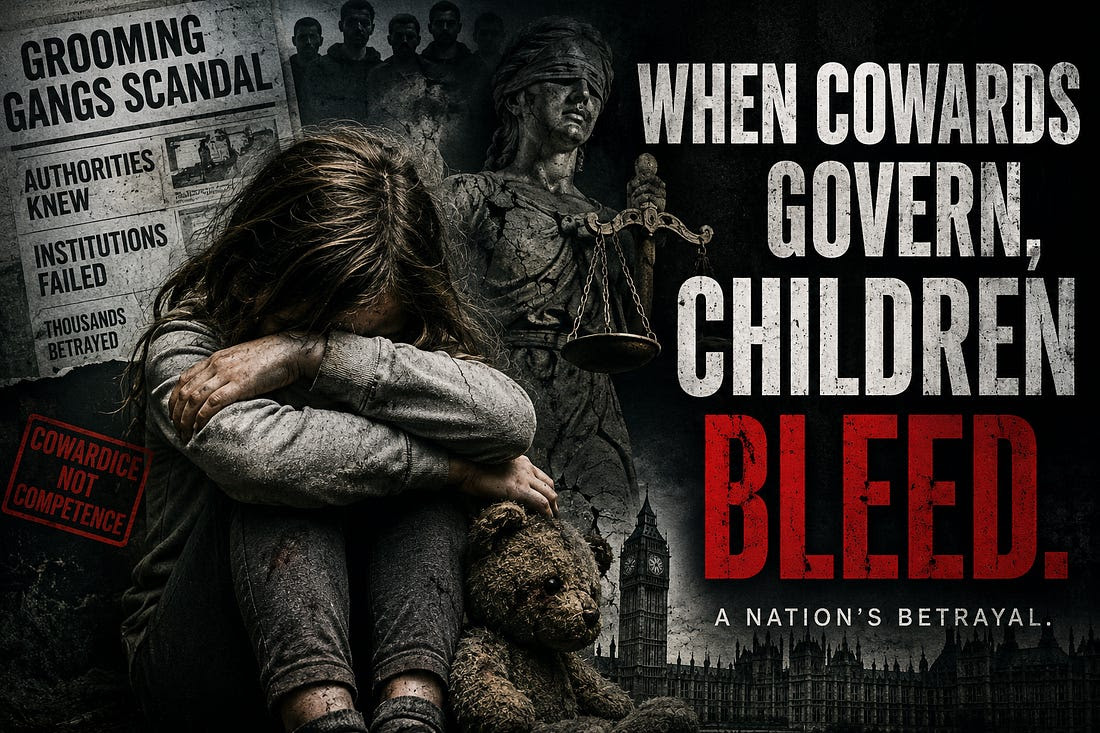
For decades, thousands of vulnerable girls were abused, raped, trafficked, tortured, and discarded in towns and cities across Britain. The facts are now beyond dispute. The reports exist. The testimonies exist. The convictions exist. The victims exist.
What remains in dispute is how this was ever allowed to happen.
The answer is as simple as it is horrifying.
Cowardice.
Not merely individual cowardice, but institutional cowardice on an industrial scale.
This was not a failure of information. It was not a failure of intelligence. It was not a failure of evidence.
It was a failure of nerve.
The people responsible for safeguarding children knew.
Police officers knew.
Social workers knew.
Councillors knew.
Teachers knew.
Officials knew.
Journalists knew.
Many ordinary citizens knew.
The warning signs were not hidden in classified documents buried in locked cabinets. They were visible in plain sight, repeated year after year, victim after victim, report after report.
Yet again and again, those charged with protecting children chose the safety of their own reputations over the safety of vulnerable girls.
The greatest scandal is not that evil men committed evil acts.
Evil has always existed.
The greatest scandal is that supposedly decent people stood aside and watched.
A civilisation begins to die when the fear of being called names becomes greater than the fear of failing in one’s duty.
That is precisely what happened.
An entire generation of leaders became more terrified of being labelled racist than they were of children being raped.
Read that sentence again.
Because future historians will struggle to comprehend it.
There were people entrusted with authority who genuinely feared a newspaper headline, a social media campaign, a professional complaint, or an uncomfortable meeting more than they feared the destruction of a child’s life.
The accusation of racism became a kind of secular blasphemy charge. It carried such social power that institutions became paralysed.
Truth was sacrificed.
Justice was sacrificed.
Children were sacrificed.
All upon the altar of public approval.
What kind of society does that?
What kind of culture becomes so morally confused that protecting its own reputation becomes more important than protecting its daughters?
The answer is a society that has lost its moral compass.
A society that has forgotten that courage is not optional.
For generations, Britain celebrated courage.
We honoured men who stood against tyrants.
We built memorials to those who faced danger rather than surrender truth.
We taught children that character meant doing what was right even when it was costly.
Yet somewhere along the way we replaced courage with compliance.
We stopped asking, “What is true?”
We stopped asking, “What is right?”
Instead we began asking, “What will people think?”
That question has destroyed more institutions than any enemy ever could.
It infected politics.
It infected the media.
It infected local government.
It infected policing.
And, if we are honest, it infected the Church as well.
Too many church leaders discovered their prophetic voice when addressing fashionable causes but somehow lost it when confronted with uncomfortable realities.
The biblical command is clear.
“Speak up for those who cannot speak for themselves.”
Not when it is convenient.
Not when it is popular.
Not when it is risk-free.
Always.
The test of courage is not whether you speak when everyone agrees with you.
The test of courage is whether you speak when silence would be safer.
Too many failed that test.
The result was not merely administrative failure.
It was moral failure.
And moral failures have victims.
Thousands of them.
Behind every statistic stands a human face.
A frightened girl.
A broken family.
A stolen childhood.
A life permanently marked by the decisions of adults who chose self-preservation over responsibility.
This is why public apologies, while necessary, are not enough.
The nation does not merely need investigations.
It needs repentance.
Repentance is not a fashionable word, but it remains an essential one.
Repentance begins by telling the truth.
The truth is that institutions failed.
The truth is that political sensitivities were elevated above child protection.
The truth is that professional careers were protected while vulnerable girls were not.
The truth is that many who should have acted chose not to act.
The truth is that cowardice became policy.
And until that truth is acknowledged, genuine reform will remain impossible.
The deeper lesson extends far beyond the grooming gangs scandal.
This is ultimately a warning about what happens when a society loses confidence in its own moral foundations.
When objective truth is abandoned, courage becomes impossible.
When right and wrong become negotiable, duty becomes optional.
When public approval becomes the highest good, justice inevitably becomes the first casualty.
The crisis before us is therefore not merely political.
It is spiritual.
For courage is not ultimately a political virtue.
It is a moral virtue.
And moral virtues do not survive for long when severed from the deeper truths that sustain them.
The Christian faith teaches that every human being is made in the image of God.
Every child.
Every girl.
Every vulnerable person.
That truth imposes obligations upon us.
It demands protection.
It demands justice.
It demands courage.
And it demands that we fear God more than we fear public opinion.
The men and women who built this nation understood that.
Their flaws were many, but they understood this much: there are some duties that must be fulfilled regardless of the cost.
That understanding now needs to be recovered.
Because if we learn nothing from this tragedy, it will happen again.
Different circumstances.
Different institutions.
Different victims.
The same cowardice.
The same silence.
The same betrayal.
History does not merely judge societies by the evil committed within them.
It judges them by whether good people had the courage to stop it.
The grooming gangs scandal will stand as one of the great stains upon modern Britain.
Not simply because evil men committed terrible crimes.
But because too many decent people looked at those crimes, understood what was happening, and lacked the courage to do what was right.
When courage dies, innocence suffers.
And when innocence suffers, the judgement falls not only upon the guilty, but upon every institution that chose silence over duty.
That is the lesson.
That is the warning.
And until we recover the courage to tell the truth regardless of the consequences, we will remain vulnerable to repeating exactly the same mistakes that betrayed an entire generation of Britain’s daughters.